 |
|
Sleeve Notes
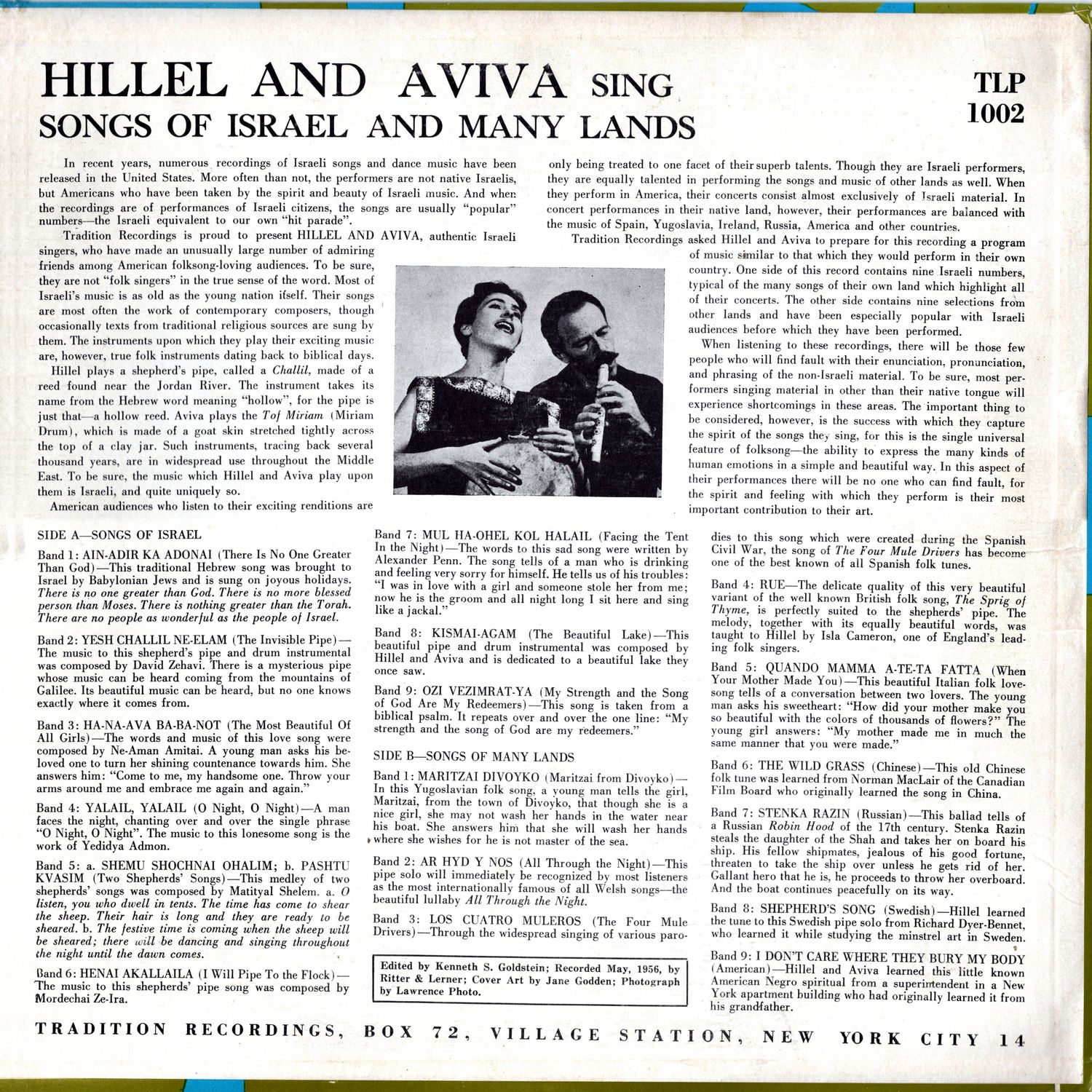
In recent years, numerous recordings of Israeli songs and dance music have been released in the United States. More often than not, the performers are not native Israelis, but Americans who have been taken by the spirit and beauty of Israeli music. And when the recordings are of performance, of Israeli citizens, the songs are usually "popular" numbers — the Israeli equivalent to our own "hit parade".
Tradition Recordings is proud to present HILLEL AND AVIVA, authentic Israeli singers, who have made an unusually large number of admiring friends among American folksong-loving audiences. To be sure, they are not "folk singers" in the true sense of the word. Most of Israeli's music is as old at the young nation itself. Their songs are most often the work of contemporary composers, though occasionally texts from traditional religious sources are sung by them. The instruments upon which they play their exciting music are, however, true folk instruments dating back to biblical days.
Hillel plays a shepherd's pipe, called a Challil, made of a reed found near the Jordan River. The instrument takes its name from the Hebrew word meaning "hollow", for the pipe is just that — a hollow reed. Aviva plays the Tof Miriam (Miriam Drum), which is made of a goat skin stretched lightly across the top of a clay jar. Such instruments, tracing back several thousand years, are in widespread use throughout the Middle East. To be sure, the music which Hillel and Aviva play upon them is Israeli, and quite uniquely so.
American audiences who listen to their exciting renditions are only being treated to one facet of their superb talents. Though they are Israeli performers, they are equally talented in performing the songs and music of other lands as well. When they perform in America, their concerts consist almost exclusively of Israeli material. In concert performances in their native land, however, their performances are balanced with the music of Spain, Yugoslavia, Ireland, Russia, America and other countries.
Tradition Recordings asked Hillel and Aviva to prepare for this recording a program of music similar to that which they would perform in their own country. One side of this record contains nine Israeli numbers, typical of the many songs of their own land which highlight all of their concerts. The other side contains nine selections from other lands and have been especially popular with Israeli audiences before which they have been performed.
When listening to these recordings, there will be those few people who will find fault with their enunciation, pronunciation, and phrasing of the non-Israeli material. To be sure, most performers singing material in other than their native tongue will experience shortcomings in these areas. The important thing to be considered. however, is the success with which they capture the tpirit of the songs they sing, for this is the single universal feature of folksong — the ability to express the many kinds, of human emotions in a simple and beautiful way. In this aspect of their performances there will be no one who can find fault, for the spirit and feeling with which they perform is their most important contribution to their art.
Songs of Isreal
AIN-ADIR KA ADONAI (There Is No One Greater Than God) — This traditional Hebrew song was brought to Israel by Babylonian Jews and is sung on joyous holidays. There is no one greater than God. There is no more blessed person than Moses. There is nothing greater than the Torah. There are no people as wonderful as the people of Israel.
YESH CHALLIL NE-ELAM (The Invisible Pipe) — The music to this shepherd's pipe and drum instrumental was composed by David Zehavi. There is a mysterious pipe whose music can be heard coming from the mountains of Galilee. Its beautiful music can be heard, but no one knows exactly where it comes from.
HA-NA-AVA BA-BA-NOT (The Most Beautiful Of All Girls) — The words and music of this love song were composed by Ne-Aman Amitai. A young man asks his beloved one to turn her shining countenance towards him. She answers him: "Come to me, my handsome one. Throw your arms around me and embrace me again and again."
YALAIL, YALAIL (O Night, O Night) — A man faces the night, chanting over and over the single phrase "O Night, O Night". The music to this lonesome song is the work of Yedidya Admon.
a. SHEMU SHOCHNAI OHALIM; b. PASHTU KVASIM (Two Shepherds' Songs) — This medley of two shepherds' songs was composed by Matityal Shelem. a. O listen, you who dwell in tents. The time has come to shear the sheep. Their hair is long and they are ready to be sheared, b. The festive time is coming when the sheep will be sheared; there will be dancing and singing throughout the night until the dawn comes.
HENAI AKALLAILA (I Will Pipe To the Flock) — The music to this shepherds' pipe song was composed by Mordechai Ze-Ira.
MUL HA-OHEL KOL HALAIL (Facing the Tent In the Night) — The words to this sad song were written by Alexander Penn. The song tells of a man who is drinking and feeling very sorry for himself. He tells us of his troubles: "I was in love with a girl and someone stole her from me; now he is the groom and all night long I sit here and sing like a jackal."
KISMAI-AGAM (The Beautiful Lake) — This beautiful pipe and drum instrumental was composed by Hillel and Aviva and is dedicated to a beautiful lake they once saw.
OZI VEZIMRAT-YA (My Strength and the Song of God Are My Redeemers) — This song is taken from a biblical psalm. It repeats over and over the one line: "My strength and the song of God are my redeemers."
Songs of Many Lands
MARITZAI DIVOYKO (Maritzai from Divoyko) — In this Yugoslavian folk song, a young man tells the girl, Maritzai, from the town of Divoyko, that though she is a nice girl, she may not wash her hands in the water near his boat. She answers him that she will wash her hands where she wishes for he is not master of the sea.
AR HYD Y NOS (All Through the Night) — This pipe solo will immediately be recognized by most listeners as the most internationally famous of all Welsh songs — the beautiful lullaby All Through the Night.
LOS CUATRO MULEROS (The Four Mule Drivers) — Through the widespread singing of various parodies to this song which were created during the Spanish Civil War, the song of The Four Mule Drivers has become one of the best known of all Spanish folk tunes.
RUE — The delicate quality of this very beautiful variant of the well known British folk song, The Sprig of Thyme, is perfectly suited to the shepherds' pipe. The melody, together with its equally beautiful words, was taught to Hillel by Isla Cameron, one of England's leading folk singers.
QUANDO MAMMA A-TE-TA FATTA (When Your Mother Made You) — This beautiful Italian folk love-song tells of a conversation between two lovers. The young man asks his sweetheart: "How did your mother make you so beautiful with the colors of thousands of flowers?" The young girl answers: "My mother made me in much the same manner that you were made."
THE WILD GRASS (Chinese) — This old Chinese folk tune was learned from Norman MacLair of the Canadian Film Board who originally learned the song in China.
STENKA RAZIN (Russian) — This ballad tells of a Russian Robin Hood of the 17th century. Stenka Razin steals the daughter of the Shah and takes her on board his ship. His fellow shipmates, jealous of his good fortune, threaten to take the ship over unless he gets rid of her. Gallant hero that he is, he proceeds to throw her overboard. And the boat continues peacefully on its way.
SHEPHERD'S SONG (Swedish) — Hillel learned the tune to this Swedish pipe solo from Richard Dyer-Bennet, who learned it while studying the minstrel art in Sweden.
I DON'T CARE WHERE THEY BURY MY BODY (American) — Hillel and Aviva learned this little known American Negro spiritual from a superintendent in a New York apartment building who had originally learned it from his grandfather.